AirHelp vs Compensair vs Skycop: which flight delay compensation service to use
Delayed 3 hours or more on an EU or UK flight? You may be owed €250 to €600 (or £220 to £520) per passenger. You can claim from the airline yourself for free; a claims company handles it for a share. Compensair takes 30% (plus up to 10% if legal costs arise), AirHelp 35% including VAT (plus 15% if the case goes to court), Skycop 44% including VAT (50% with legal proceedings). This guide explains the rules and helps you decide whether to claim yourself or which service to use.
Comparison at a glance
| Service | Best for | Starting price | Free plan / trial | Key limit | Review & sign-up |
|---|---|---|---|---|---|
| AirHelp | Hands-off claims with court costs covered, or frequent flyers on AirHelp+ | 35% of compensation (incl. VAT), only if paid | Free eligibility check; nothing to pay if the claim fails | +15% legal action fee if court is needed (50% total) | AirHelp review →Get AirHelp → |
| Compensair | Lower fee; EU, Turkish and Canadian passenger rules | 30% of compensation, only if paid | Free flight check; nothing to pay if the claim fails | Up to +10% legal fee; bank fees yours; payout within 30 business days | Compensair review →Get Compensair → |
| Skycop | Fixed euro fees known upfront; referral gift of €25–€75 | €110/€176/€264 per €250/€400/€600 award (44%, incl. VAT), only if paid | Free eligibility check; nothing to pay if the claim fails | 50% with legal proceedings; bank fees on international transfers yours | Skycop review →Get Skycop → |
Disclosure: the sign-up buttons in this table are affiliate links. If you sign up through one, we may earn a commission at no extra cost to you. Commissions don't decide which services we include or what we say about them.
The short answer
If your airline has already said no, or you simply don't want to deal with forms and follow-ups, a claims company does the chasing for a share of the payout. Compensair takes the smallest standard cut: 30% under its payment policy, plus a possible 10% legal fee if it has to pay for lawyers or court. AirHelp charges 35% including VAT, plus 15% if your case goes to court, and sells an annual membership (AirHelp+) that lets members keep the full amount on future trips. Skycop charges the most, 44% including VAT (50% with legal proceedings), but a referral gift of up to €75 narrows the gap.
If the airline is cooperative, claiming directly costs nothing and you keep 100%.
What EU261 and UK261 say you may be owed
In the EU, Regulation 261/2004 covers flights within the EU on any airline, flights leaving the EU on any airline, and flights arriving in the EU on an EU airline. According to the EU's official Your Europe passenger rights page, you may be entitled to compensation if you reach your final destination 3 hours or more late, or if your flight is cancelled at short notice or you are denied boarding. The amount depends on distance, per passenger:
| Flight distance | EU (Regulation 261/2004) | UK (UK261) |
|---|---|---|
| Up to 1,500 km | €250 | £220 |
| 1,500–3,500 km (and intra-EU flights over 1,500 km) | €400 | £350 |
| Over 3,500 km | €600 | £520 (£260 if 3–4 hours late) |
After Brexit the UK kept the same rules with pound amounts; the UK Civil Aviation Authority's delays page lists the figures above. If you were rerouted and arrived reasonably close to your original time, the EU amount can be cut by 50%.
Compensation is separate from care: during a long wait the airline must also provide meals and refreshments, and a hotel if the delay runs overnight.
This is a summary, not legal advice. Check the official rules for your exact route before you claim.
When the airline doesn't have to pay
Airlines are not liable for compensation when the disruption was caused by extraordinary circumstances. The EU lists examples such as air traffic management decisions, political instability, adverse weather and security risks. Most technical faults and strikes by the airline's own staff do not count, which is where many disputes start: an airline may cite "operational reasons" that don't actually qualify.
Time limits are set nationally, not by the regulation itself. AirHelp says that in most cases you can claim up to three years after the disruption; Compensair says flights from the last 2–6 years may still be claimable; Skycop stresses there is no universal deadline. If your flight is older, check the official rules for the relevant country before you give up or sign anything.
Claiming directly from the airline (free)
You don't need anyone's help to claim. Both official sources say the first step is a complaint to the airline itself, and that costs nothing:
- Send a written claim to the operating airline with your booking reference, flight number, date and what happened. Most airlines have an online form.
- Keep your boarding pass, booking confirmation and any messages about the delay or cancellation.
- EU: if the airline doesn't answer within 2 months or you are unhappy with its reply, complain to the national enforcement body where the incident happened, or use ADR or the European Small Claims procedure.
- UK: if the airline's final response doesn't satisfy you, or it takes more than eight weeks, go to an approved ADR scheme or the CAA's Passenger Advice and Complaints Team.
The catch is time: airlines can be slow or push back on "extraordinary circumstances". That is the gap claims companies fill.
What we compared
For a delayed passenger, four things decide whether a claims company is worth its fee:
- Fee model: the share taken from your compensation, and whether VAT is included.
- Court costs: all three cover legal costs themselves, but each adds an extra percentage when a case goes to court.
- Coverage: which passenger-rights rules they work under, such as Canadian or Turkish ones.
- Payout terms: how you get paid, how long it takes, and who pays bank charges.
Fees side by side: what you actually receive
Here is what a €600 award looks like with each service, using their published rates:
| On a €600 award | AirHelp | Compensair | Skycop |
|---|---|---|---|
| Standard fee | 35% (incl. VAT) | 30% | €264, 44% (incl. VAT) |
| You receive, standard case | €390 | €420 | €336 |
| Fee if court/legal action needed | 50% in total | up to 40% in total | €300, 50% in total |
| You receive, legal case | €300 | €360 | €300 |
Compensair's payment policy says it reserves the right to add the 10% legal fee when it incurs extra legal costs such as external lawyers, court fees or translations, so a court case does not automatically mean the higher fee. Skycop's price list sets fixed amounts per award: €110, €176 or €264 for €250, €400 or €600.
Bank fees are yours with Compensair, and with Skycop on international transfers. All three are no win, no fee: if the claim fails, you owe nothing. With Compensair and Skycop, if the airline pays you directly after you signed up, you must tell the company and pay its fee yourself.
AirHelp: strengths and downsides
AirHelp is operated by AirHelp Germany GmbH in Berlin and handles delays, cancellations, denied boarding and missed connections. After a free check and a signed agreement, AirHelp deals with the airline, including court if needed.
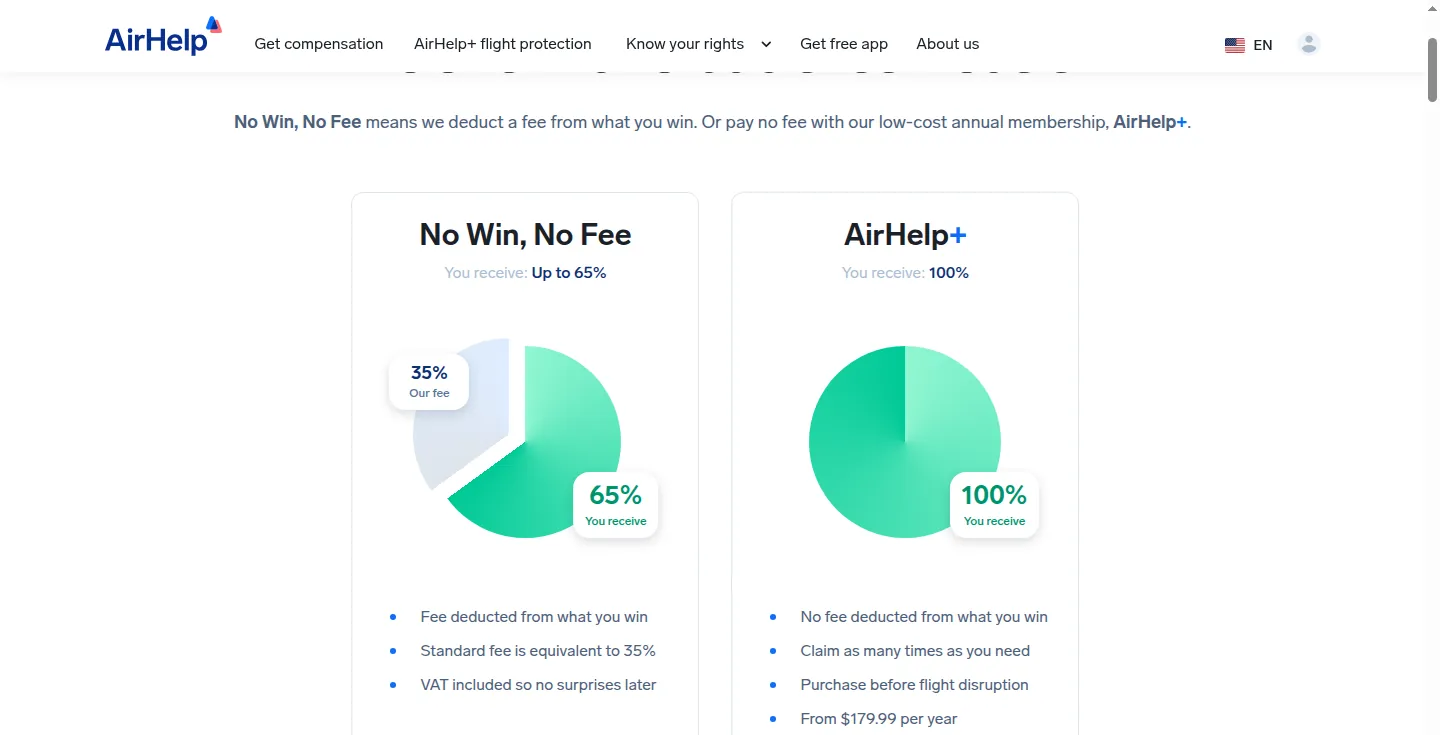
Why pick it: AirHelp covers court and lawyer costs itself, and says legal action is needed in about 3% of cases. Its AirHelp+ membership suits frequent flyers: members keep 100% of compensation AirHelp claims for them. On the AirHelp+ page the plans are €39.99 a year for 3 trips or €99.99 a year for 9 trips, and benefits apply only while the membership is active, so it won't help with a flight that has already gone wrong.
Downsides: 35% standard, and up to 50% in total when court action was necessary. EU, EEA and UK consumers can withdraw within 14 days; later, ending the agreement may cost you fees. More detail in our AirHelp review.
Compensair: strengths and downsides
Compensair files claims for delayed and cancelled flights, denied boarding and missed connections under EU Regulation 261/2004, Turkish air passenger rights and Canada's Air Passenger Protection Regulations. The flight check is free.
Why pick it: the lowest standard fee (30%) and a smaller extra legal fee (10%, charged only if Compensair incurs added legal costs). Its FAQ says some airlines answer within 2–3 days, a pre-court settlement takes about 8 weeks on average, and court cases can run 16–20 weeks.
Downsides: after the airline pays, Compensair asks for a passport copy and bank details, then transfers the money within 30 business days, and bank fees are yours. If you don't send payout details within six months, the right to the compensation passes to the company. The website footer names a London address while the payment policy names Compensair Business Group Pte. Ltd., so read the terms before signing. Full details in our Compensair review.
Skycop: strengths and downsides
Skycop is operated by UAB Skycop.com in Vilnius, Lithuania, and handles delays, cancellations, overbooking, missed connections and airline strikes under EU261 and UK261; it also publishes guides to Turkish, Brazilian and Canadian rules. After a free eligibility check and an assignment agreement, Skycop deals with the airline, going to court at its own cost if needed.
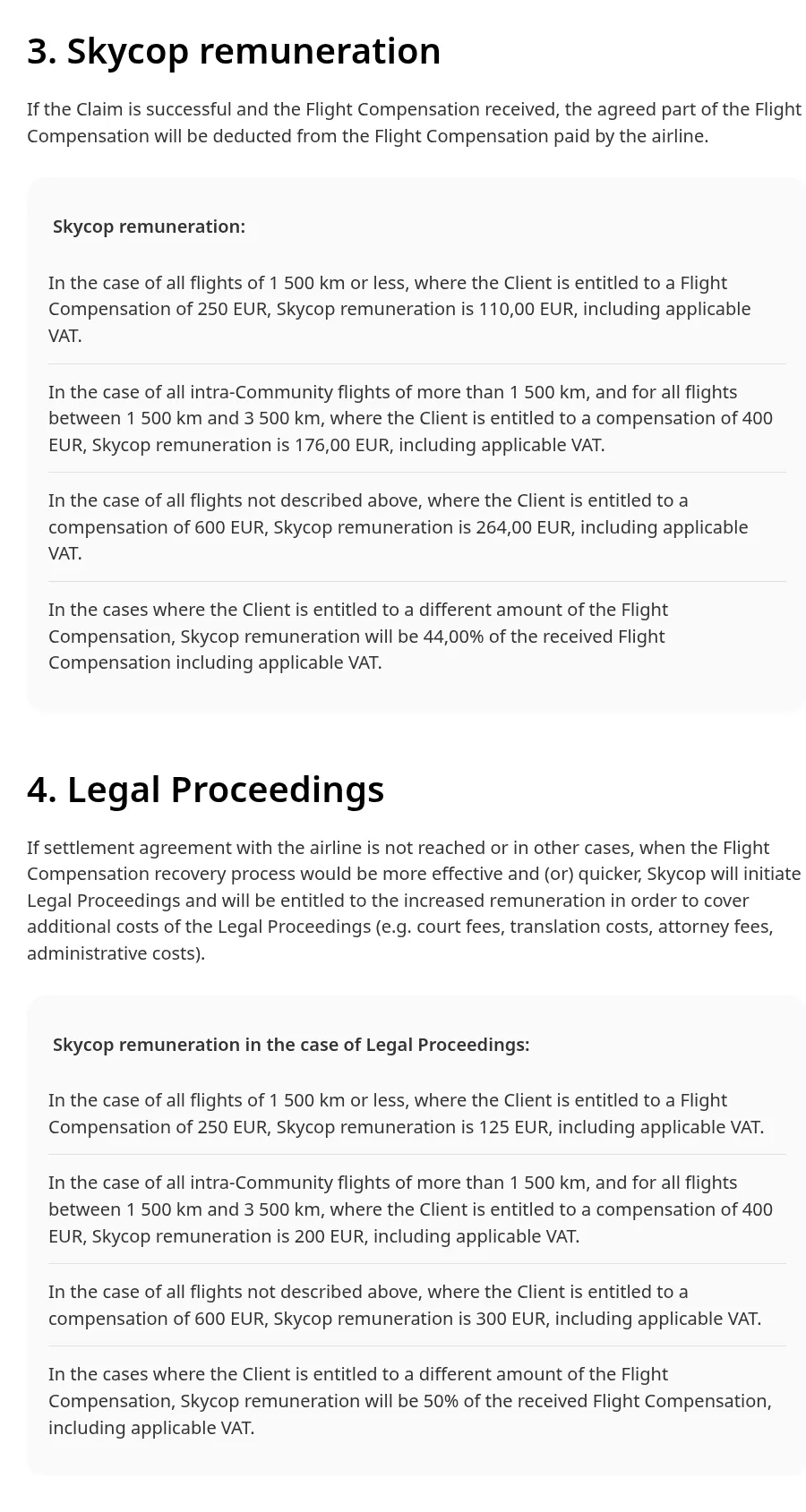
Why pick it: fees are fixed euro amounts in a published price list, so you know your payout in advance. Its refer-a-friend programme gives a referred passenger a gift of €25, €50 or €75 (for a €250, €400 or €600 award) once the airline approves the claim; the Skycop button in the table above opens a referral link.
Downsides: the highest standard fee of the three (€336 left from €600), and the gift cannot be exchanged for cash and is excluded for bank accounts in some countries, including Russia and Indonesia. Consumers can withdraw within 14 days of signing. Full details in our Skycop review.
Is AirHelp worth it? Who should pick which
- Claim yourself if the airline has a working claims form and admits the delay was its fault. You keep the full €250–€600 (or £220–£520).
- Pick Compensair if you care most about the fee: 30% versus 35% means €30 more on a €600 award than with AirHelp, €60 more if it goes to court. It's also the choice for Turkish or Canadian routes.
- Pick AirHelp if you fly often and want AirHelp+ so future claims cost no fee, or you value a VAT-inclusive fee with a published worked example.
- Pick Skycop if you prefer fixed euro fees set out in advance or a friend has referred you, so the €25–€75 gift offsets part of its higher fee.
- Use any of them if the airline has ignored or rejected your claim and you don't want to take it further alone: all three carry the cost and risk of court.
Delayed on a trip abroad? See our guide on how to choose a travel eSIM, or browse more travel services.
Frequently asked questions
AirHelp vs Compensair vs Skycop: which charges less?
Compensair, at 30% plus up to 10% if it incurs extra legal costs. AirHelp charges 35% including VAT (50% with court action) and Skycop 44% including VAT (50% with legal proceedings). On a €600 award that leaves €420, €390 and €336 in a standard case.
How much flight delay compensation can I get?
Under EU rules, €250, €400 or €600 per passenger depending on distance, if you arrive 3 hours or more late and the cause wasn't extraordinary. UK rules pay £220, £350 or £520 (£260 on long flights 3–4 hours late).
Can I claim EU261 compensation without a claim company?
Yes. You can claim directly from the airline for free, and both the EU and the UK CAA say to start there. If the airline refuses or doesn't reply, you can escalate to the national enforcement body, an ADR scheme or a small claims court.
How long do I have to claim flight delay compensation?
It depends on the country whose courts would hear the case, because limits are set nationally. AirHelp says most flights can be claimed up to three years later; Compensair says 2–6 years depending on the airline and route. Check the official rules for your case.
Do weather delays qualify for compensation?
Usually not. Adverse weather, air traffic control decisions and security risks count as extraordinary circumstances. Most technical faults and strikes by the airline's own staff do not, so those delays often do qualify.