Best crypto staking platforms: where to stake and earn on your coins
Staking pays you rewards for locking proof-of-stake coins to help secure a network. Where you stake decides who holds your keys, what you pay and how fast you can get out. The short answer: Allnodes if you want non-custodial staking or a hosted validator node, Ledger if you want to stake ETH or SOL straight from a hardware wallet, and YouHodler if you prefer a simple custodial yield account and accept that it holds your coins. Based and Hive OS cover two different cases: staking a platform token and mining proof-of-work coins. Crypto is high risk; this is not investment advice.
Crypto-assets are highly volatile and largely unregulated in many countries. You can lose all the money you put in. Not investment advice.
In the EU/EEA, check that the provider is authorised under MiCA in your country.
18+ only.
Comparison at a glance
| Service | Best for | Starting price | Free plan / trial | Key limit | Review & sign-up |
|---|---|---|---|---|---|
| Allnodes | Non-custodial staking and hosted validator nodes | Staking: no subscription; ETH validator from $5/mo + $5 setup | 3-day free trial on Advanced and Enterprise hosting | Own validator needs the full stake (e.g. 32 ETH); no refunds | Allnodes review →Get Allnodes → This offer is not available in your country. |
| Ledger | Staking ETH, SOL and stablecoins from a hardware wallet | Device from $69; no Ledger staking fee | Ledger Wallet app is free | Staking via third-party providers; availability varies by region | Ledger review →Get Ledger → |
| YouHodler | Custodial yield on BTC, ETH and stablecoins | No subscription, no minimum deposit | Free account | Custodial, mandatory KYC; no rewards for UK residents | YouHodler review →Get YouHodler → This offer is not available in your country. |
| Based (Hyperliquid app) | Based traders staking $BASED for rewards and fee cuts | No subscription; 60,000 $BASED for a 30% fee discount | Free to stake | Rewards in a volatile new token; 3-day unstake cooldown | Based (Hyperliquid app) review →Get Based (Hyperliquid app) → This offer is not available in your country. |
| Hiveon / Hive OS | GPU and ASIC mining (proof-of-work, not staking) | $0.50-$3 per GPU rig per month | 2 workers free | Crypto-only, non-refundable balance | Hiveon / Hive OS review →Get Hiveon / Hive OS → |
Disclosure: the sign-up buttons in this table are affiliate links. If you sign up through one, we may earn a commission at no extra cost to you. Commissions don't decide which services we include or what we say about them.
The short answer
Each option below puts idle crypto to work in a different way:
- Pick Allnodes if you want to keep your coins in your own wallet and delegate to a professional validator, or pay someone to run your own validator or masternode. Staking has no subscription, and an Ethereum validator is hosted from $5 a month.
- Pick Ledger if your coins already live on a Ledger, or should. The free Ledger Wallet app lets you stake ETH, SOL and selected stablecoins through third-party providers, and Ledger itself charges no staking fee.
- Pick YouHodler if you want one app with fixed per-coin rates and weekly payouts, and you are comfortable with a custodial service that requires KYC.
- Look at Based only if you already trade on it: staking its own $BASED token pays emission rewards and cuts trading fees, but the reward is the same volatile token.
- Look at Hive OS if your coin is mined, not staked. It manages GPU rigs and ASICs, with two workers free.
How staking works, and what it doesn't promise
On a proof-of-stake network such as Ethereum or Solana, validators lock coins as collateral and earn new coins for producing and checking blocks. Running your own validator needs the full stake (32 ETH on Ethereum) and a server online around the clock. Most people therefore delegate: they assign their coins to someone else's validator and share the rewards, minus the validator's commission.
Three things are easy to miss:
- The reward is paid in the coin you stake. A 5% APR on a coin that falls 30% in a year is still a loss in dollars.
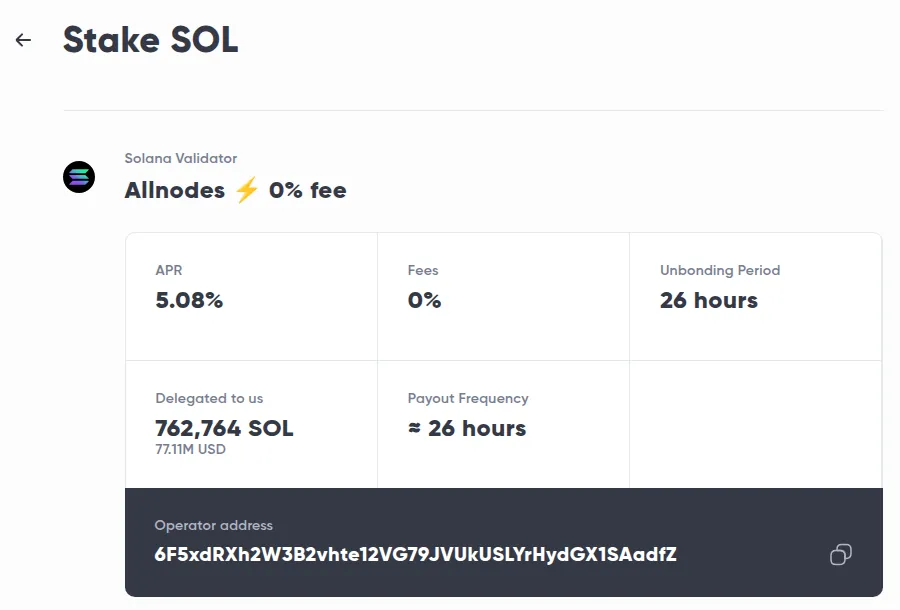
- Unbonding takes time. Many networks keep your coins locked for a period after you unstake. Allnodes' Solana page shows about 26 hours; other networks take longer.
- Validators can be penalised. If a validator misbehaves or goes offline, the protocol can cut (slash) part of the stake.
Custodial "earn" accounts are a different product. The platform holds your coins, sets the rate and decides how it generates the return. YouHodler's earn page lists rates and payouts but does not describe the product as staking, so treat it as yield from a custodian, not as on-chain delegation.
How to choose a staking platform
These criteria matter more than the headline APR, and they apply equally to exchange staking at Coinbase, Kraken or Binance and to liquid staking protocols such as Lido.
- Custody. Non-custodial staking (Allnodes, Ledger) keeps your private keys with you; the coins go to the network's staking contract, not to a company account. Custodial earn (YouHodler) is simpler, but you depend on the company staying solvent and honest, and crypto holdings are not covered by deposit protection.
- Fees. Delegation usually costs a commission taken from rewards. Allnodes' Solana validator showed a 0% fee when we checked; Ledger charges no staking fee of its own, but the third-party provider you choose may.
- Supported coins. Check that your exact coin and network are listed. Allnodes lists 96 blockchains; Ledger Wallet's staking covers ETH, SOL and selected stablecoins.
- Lock-ups and exit. Read the unbonding period for your network and any platform-side term. Based's $BASED staking has a 3-day unstake cooldown, during which tokens earn nothing.
- KYC and region. YouHodler requires identity verification and gives no rewards or sign-up offers to UK residents. In the EU, check that a provider is authorised under MiCA in your country.
Allnodes: best for non-custodial staking and hosted nodes
Allnodes, operated by Allnodes Inc. since 2018, is an infrastructure platform rather than an exchange. You can stake on dozens of proof-of-stake networks by delegating to Allnodes validators from your own wallet (Ledger, Trezor, MetaMask, Phantom or Solflare), or host your own validator, masternode or full node while rewards go to your own address. The homepage lists 96 blockchains.
Staking itself has no subscription; the validator takes a commission that varies by network. On the Allnodes SOL staking page we read a 0% fee, 5.08% APR, a 26-hour unbonding period and payouts roughly every 26 hours.
If you hold a full validator's worth of coins, hosting replaces the hardware: an Ethereum validator costs $5 a month plus a $5 setup fee on Basic, or $10 a month on Advanced, which comes with a 3-day free trial. Ethereum validators include basic slashing insurance on every plan.
The downside: running your own validator still needs the network's full stake, such as 32 ETH, and the terms rule out refunds, including prepaid Basic time and setup fees. More detail in our Allnodes review.
Ledger: best for staking from a hardware wallet
If security comes first, staking from a hardware wallet keeps your private keys offline while the coins earn. Ledger's free Ledger Wallet app (formerly Ledger Live) has an Earn section where you stake ETH, SOL and selected stablecoins through third-party providers. Ledger states it charges no staking fee, that you keep control of your keys even when you delegate, and that you can unstake whenever you want, subject to each network's unbonding period. See Ledger's staking page for the current list.
The devices start at $69 for the Nano S Plus, which works with desktop and Android but not the iPhone app; the Nano X at $99 adds Bluetooth.
The downside: the staking services come from third parties, so availability, rates and their fees vary by region, and rewards are not guaranteed. You also need to buy the device first. Our Ledger review covers the models, and the best hardware wallets guide compares it with alternatives.
YouHodler: best for a simple custodial yield account
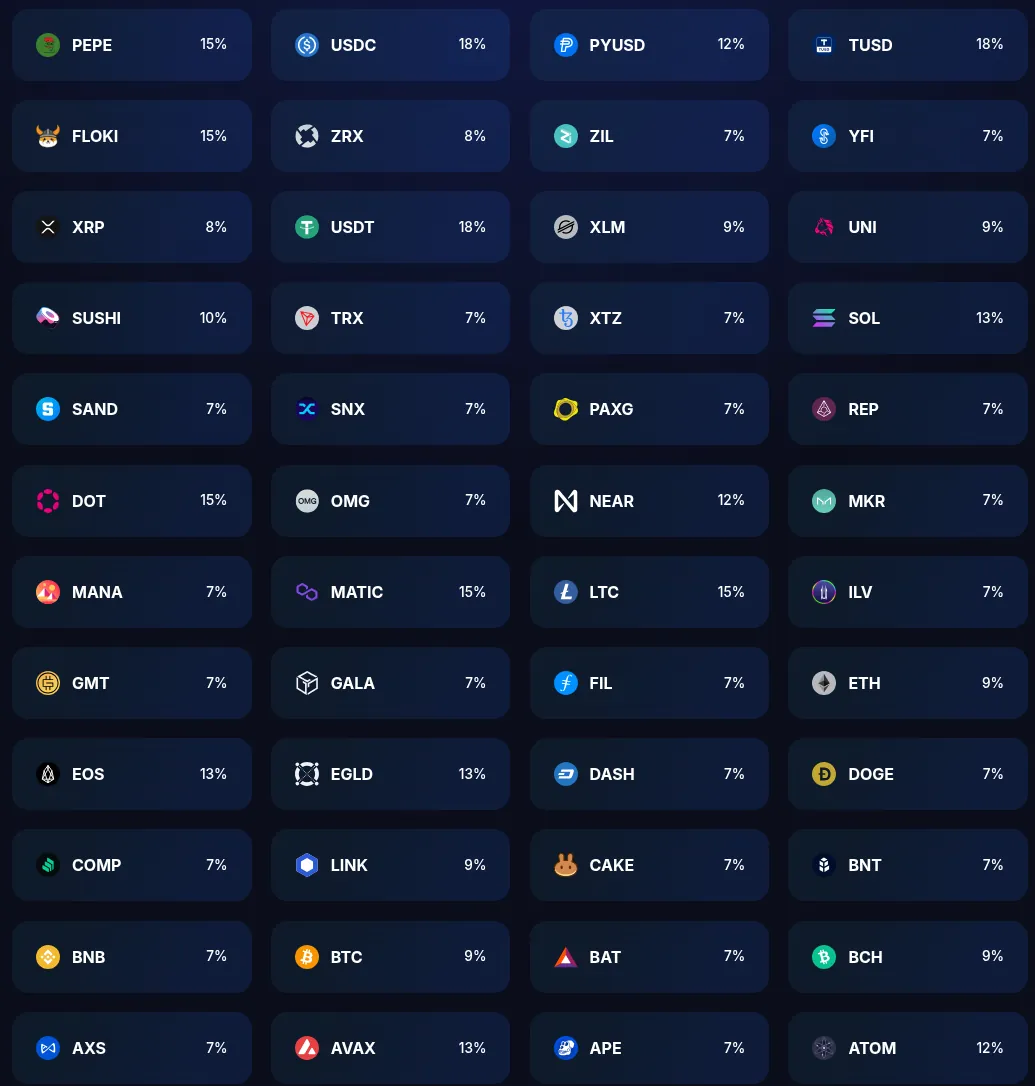
YouHodler, run by YouHodler SA in Switzerland, pays per-coin rates on deposited crypto and stablecoins. When we checked, its earn page listed 9% for BTC and ETH, 13% for SOL and 18% for USDT and USDC, with no minimum deposit and payouts commonly every 7 days. The same page's text promises "up to 15% p.a.", so check the live rate in the app.
YouHodler SA is a Swiss registered financial intermediary, with VASP registrations in Italy, Spain and Argentina, and says assets are held with Fireblocks custody.
The downside: it is custodial, so your coins are not in your own wallet, and the earn page does not explain how the yield is generated. Rates change with the market. KYC with an international passport or ID card is mandatory. YouHodler has no FCA-regulated UK entity, and UK residents get no rewards or sign-up offers. Its own warning: don't invest unless you're prepared to lose all the money you invest. More detail in our YouHodler review.
Based: staking a platform token for rewards and fee discounts
Based is a trading app on Hyperliquid for crypto, stock and commodity perpetual futures. Its staking is not network staking: you stake the platform's own $BASED token. According to Based's documentation, stakers receive emission rewards whose APR is dynamic and falls as more $BASED is staked, plus discounts on Based builder fees: 30% from 60,000 tokens, 60% from 300,000 and 100% from 600,000.
There is a 3-day unstake cooldown, during which tokens earn nothing.
The downside: rewards are paid in the same new token, so a high APR can be wiped out by its price, and the documentation calls its APR table illustrative only. The site does not name an operating company. More detail in our Based review.
Hive OS: if your coin is mined, not staked
Bitcoin and other proof-of-work coins cannot be staked; they are mined with GPU rigs or ASICs. If that is your situation, Hive OS (now branded Hiveon OS) is a web-managed operating system that lets you monitor hashrate, switch coins and pools and reboot rigs remotely.
The first two workers are free, with no coin, pool or GPU-count limits. Beyond that, GPU rigs cost $0.50 to $3 a month depending on card count, ASICs $2 a month via ASIC Hub or free on Hiveon firmware (which carries a 2 to 2.8% dev fee). Once you have 3 or more workers, all of them are billed.
The downside: billing is crypto-only, the prepaid balance is non-refundable, and the free tier keeps only 3 days of stats. The terms exclude residents of Russia, Belarus, Iran and North Korea. More detail in our Hive OS review.
Risks to understand before you stake
Crypto-assets are highly volatile and largely unregulated in many countries. You can lose all the money you put in. Nothing here is investment advice.
- Price risk can outweigh the yield: rewards are paid in coins whose price can fall.
- Platform risk: if a custodial company fails or freezes withdrawals, your coins may be stuck.
- Protocol risk: slashing, bugs in staking contracts and unbonding delays can cost you or trap your funds when you want out.
- Taxes: staking rewards are often taxable when received. The best crypto tax software guide covers tools that track them.
In the EU, check that the provider is authorised under MiCA in your country. For more ways to put crypto to work, browse DeFi and crypto earning services.
Frequently asked questions
What is the best crypto staking platform?
It depends on custody. If you want to keep your keys, delegate through Allnodes or stake from a Ledger wallet. If you prefer a simple app with fixed rates and accept that the company holds your coins, YouHodler is the custodial option.
What is staking as a service?
Staking as a service means a provider runs the validator for you. With Allnodes you either delegate your coins to its validators or pay a monthly fee to host your own validator node, while rewards go to your own wallet address.
Is staking crypto safe?
No form of staking is risk-free. The coin's price can fall more than the rewards you earn, validators can be slashed, and custodial platforms can fail or freeze withdrawals. Non-custodial staking removes the platform risk but not the price risk.
Can I unstake my crypto at any time?
You can usually request it at any time, but many networks have an unbonding period before the coins are free. Allnodes' Solana page showed about 26 hours, and Based's $BASED staking has a 3-day cooldown. Custodial accounts set their own withdrawal rules.
Can I stake Bitcoin?
Bitcoin uses proof-of-work, so it cannot be staked natively. Platforms that pay yield on BTC, such as YouHodler, do it as a custodial product. To earn new coins on proof-of-work networks, you mine them, which is what Hive OS manages.
- Allnodes SOL staking
- Allnodes homepage
- Allnodes Ethereum validator pricing
- Allnodes terms
- Ledger staking
- Ledger Wallet app
- Ledger hardware wallet comparison
- YouHodler earn crypto
- YouHodler company
- YouHodler: how to verify your identity
- Based docs: staking $BASED
- Based docs: fees
- Hiveon OS pricing
- Hiveon OS terms